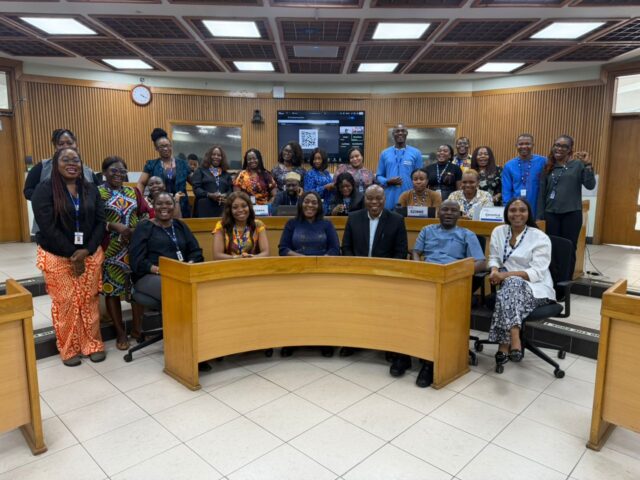
AMSCO Nigeria delivered a two-day Total Quality Management (TQM) Workshop to Program Managers at Lagos Business School, Pan-Atlantic University, in Lekki, Lagos. Held under the theme “Building a Culture of Excellence Across Every Function,” the workshop was designed to equipe participants with a practical understanding of how quality is created, where it can break down, and how sustainable improvements can be integrated into everyday work.
Moving from Quality Principles to Practical Application
The workshop focused on the core principles of Total Quality Management, including customer focus, employee involvement, a process-based approach, continual improvement, fact-based decision-making, and effective communication. Rather than approaching these principles solely from a theoretical perspective, the sessions connected them to real institutional processes and workplace challenges.
Participants explored process mapping as a way of understanding how workflows across functions, identifying potential gaps, and clarifying how individual roles contribute to broader organizational outcomes. Group exercises and presentations provided opportunities to apply these concepts directly to practical situations.
Understanding the Voice of the Customer
A key component of the program was the Voice of the Customer, which examined the importance of continuously listening to and understanding customer needs and expectations.
Participants explored a structured Listen–Analyze–Act–Review approach, alongside tools such as surveys, interviews, focus groups, complaint analysis, and digital listening. The sessions also examined transformative customer experience through dimensions including responsiveness, reliability, personalization, coherence, and aspiration.
Building a Culture Where Quality Becomes Everyone’s Responsibility
The program also looked beyond compliance to examine what it takes to build a sustainable quality culture. Participants explored the progression from inspection and quality control towards quality assurance, quality management, and ultimately a culture in which quality becomes embedded in everyday behaviors and decision-making.
Leadership behavior, psychological safety, recognition, documentation, feedback, and continuous improvement were considered important elements in creating an environment where teams can take ownership of quality and contribute to organizational improvement.
Finding Root Causes, Not Just Symptoms
Another practical focus was the Five Whys technique, a structured approach to identifying the underlying causes of problems rather than addressing only their visible symptoms.
Through this approach, participants were encouraged to use evidence, avoid assumptions and blame, and develop solutions that address the source of recurring issues. The technique was also connected to the PDCA (Plan–Do–Check–Act) cycle to support continuous improvement and follow-through.
The workshop ultimately provided Program Managers with a practical toolkit for strengthening processes, understanding customer expectations, identifying root causes, and developing time-bound improvement plans. The evaluation findings further highlighted areas such as documented and communicated SOPs, supervision and follow-through, and feedback loops as important areas for continued attention.
By bringing together practical tools, collaborative exercises, and real workplace scenarios, the TQM workshop reinforced the importance of making quality an integral part of how organizations operate and improve.
Through tailored learning and development interventions, AMSCO continues to support organizations in strengthening capabilities, improving performance, and building sustainable organizational excellence.

 English
  French